
Arduino compatible WIFI development board based on ESP-8266EX microcontroller with 11 I/O pins, 1 ADC pin, onboard 5V 1A switching power supply supporting OTA wireless upload for IoT and electronics projects


Arduino compatible WIFI development board based on ESP-8266EX microcontroller with 11 I/O pins, 1 ADC pin, onboard 5V 1A switching power supply supporting OTA wireless upload for IoT and electronics projects
ESP-8266EX WIFI Development Board with Arduino Compatibility and OTA Wireless Upload
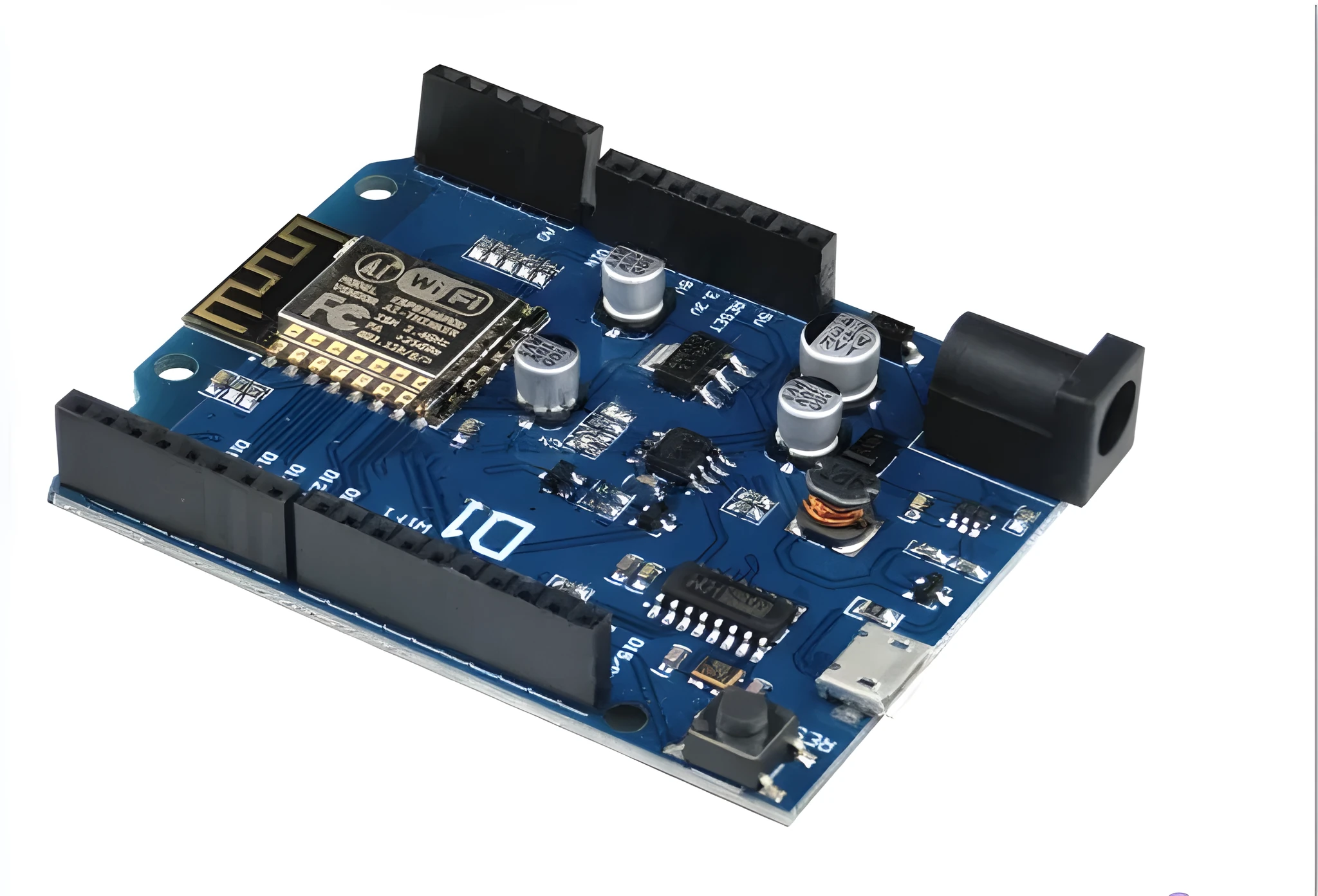
This development board centres around the ESP-8266EX microcontroller, providing a dedicated platform for creating WIFI-enabled electronics projects with familiar Arduino workflow integration. Designed to reduce barriers for makers and developers transitioning to wireless applications, it maintains compatibility with the widely-used Arduino IDE while adding remote programming capabilities through OTA upload. The board eliminates the need for separate WIFI modules by integrating wireless connectivity directly into its core architecture, supported by an onboard switching power supply that simplifies external power requirements. For those experienced with Arduino UNO boards, the operational similarity reduces learning time while expanding project possibilities into the Internet of Things domain.
Features and Construction

The board's architecture prioritises both wireless capability and practical development features, balancing connectivity with hands-on electronic interfacing. Its construction focuses on providing essential development resources while maintaining physical and programming compatibility with existing Arduino ecosystems.
Material and Build
Manufactured on a black printed circuit board, the development board incorporates the ESP-8266EX microcontroller as its central processing unit alongside supporting electronic components for power regulation, signal conditioning, and connectivity interfaces. The physical build follows standard development board conventions with clearly labelled pins and connectors, while the colour scheme provides visual contrast for component identification. No specialised coatings or protective finishes are mentioned in the source materials, suggesting standard PCB construction suitable for prototyping environments rather than harsh industrial conditions.
Size and Practical Fit
While specific dimensional measurements aren't provided, the board appears designed for typical benchtop prototyping use rather than ultra-compact final product integration. The layout includes 11 digital I/O pins and one ADC pin arranged for accessibility, suggesting consideration for breadboard compatibility and wire connection ease. The absence of extreme miniaturisation indicates prioritisation of developer convenience over space constraints, suitable for educational settings, hobbyist projects, and prototyping phases where component accessibility matters more than minimal footprint.
Uses and Placement
This development board serves both educational purposes and practical prototyping applications, bridging introductory electronics with Internet of Things implementation. Its feature set supports progression from basic input/output experiments to networked device creation without requiring platform switching.
Event or Professional Use
In workshop or educational environments, the board facilitates WIFI connectivity demonstrations and IoT prototyping exercises with minimal setup complexity. The Arduino compatibility allows instructors to leverage existing tutorial materials while adding wireless dimensions to standard exercises. For professional prototyping, the OTA wireless upload capability supports remote debugging and updating of deployed test units, while the 24V maximum input range accommodates various power supply scenarios commonly encountered in industrial settings. The ESP-8266EX foundation provides reliable WIFI connectivity for proof-of-concept devices before custom PCB design.
Everyday Home Use
Home makers and hobbyists can utilise this board for smart home projects, environmental sensors, and connected devices without deep wireless networking expertise. The Arduino IDE compatibility means countless existing code examples and libraries can be adapted for WIFI applications with moderate modification. The onboard 5V 1A switching power supply simplifies integration with common household adapters and USB power sources, while the 0-3.3V ADC input range suits most sensor interfacing needs for temperature, light, or moisture monitoring. Home automation prototypes benefit particularly from the remote update capability when devices are installed in difficult-to-reach locations.
Benefits and Buying Value
The development board offers value through reduced project complexity and extended device capabilities compared to separate microcontroller and WIFI module combinations. Its integrated approach saves both physical connection complexity and programming overhead associated with managing separate components.
Reuse and Low Maintenance
The board supports multiple project cycles through standard pin interfaces that don't require soldering for temporary connections, while the OTA wireless upload feature eliminates physical connection needs for programming updates. This extends useful life across different prototyping phases and reduces wear on USB connectors. The robust 24V maximum input specification protects against accidental overvoltage in learning environments, while the switching power supply design generates less heat than linear regulators during extended operation. No specialised maintenance is indicated beyond standard electronic handling precautions.
Why Choose This Product
This board addresses the specific need for WIFI-enabled development without abandoning the Arduino ecosystem's resources and community support. It provides measured advantages over generic ESP-8266 modules through integrated power regulation, organised pin access, and designed-for-development physical layout. The explicit Arduino UNO operational similarity offers a clear migration path for existing Arduino users, while the OTA capability delivers practical convenience for deployed prototypes. Selection makes particular sense when project requirements include both wireless connectivity and rapid prototyping with extensive code library support.